About me

I'm a computational evolutionary biologist interested in using and developing new frameworks to extract all possible information from virus genomes to better control infectious disease.

I work in the field of phylodynamics, which is the combination of evolutionary biology, immunology, and epidemiology. I like to think of it as combining genomic and non-genomic data to reconstruct how, when, and where viruses spread.

I am a Wellcome Trust Early Career Award holder at the Centre for Virus Research at the University of Glasgow.

To see where I’ve been and what I do, take a look at my CV and selected publications.

If you’re looking to collaborate, start a PhD or postdoc in phylodynamics, or a journalist looking to chat about virus evolution and how it impacts public health, get in touch!
Research

I apply my methods across various RNA viruses. I've worked on respiratory viruses like SARS-CoV-2 and RSV, arboviruses including Dengue virus and various weird rare ones including Eastern Equine Encephalitis and Jamestown Canyon Viruses, and I started my PhD on Ebola (although that is unpublished, thanks COVID).

My focus at the moment is on the emergence of Crimean-Congo Haemorrhagic Fever Virus (CCHFV) in Uganda, and the elimination of Hepatitis C virus in the UK, but I'm happy to collaborate/supervise work on others, especially dengue.

Phylodynamics for emergence and elimination

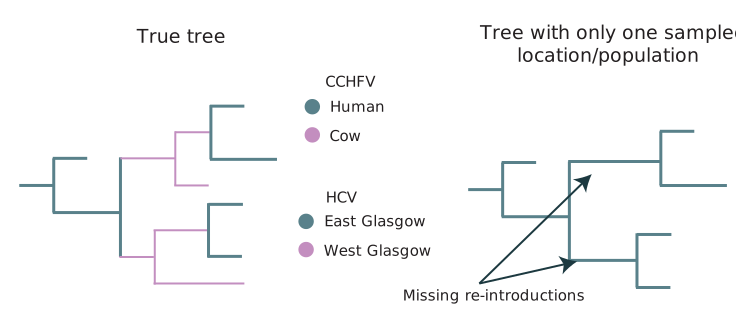
Phylodynamics gives us extra information about unobserved processes with relatively small amounts of data. Emergence and elimination are stages of an outbreak where controlling individual transmission chains results in disprportionate impacts. But, many of our existing methods work best at endemicity and/or the peak of an epidemic. I’m interested in developing new ways of using existing frameworks to extract as much information out of hard-won genomes as possible. I’m especially interested in developing new ways of using imperfect genomic datasets (i.e. heavily biassed in space or time) so that we can all avoid simply writing a sentence in the Discussion and calling it a day.

Spatial spread of viruses

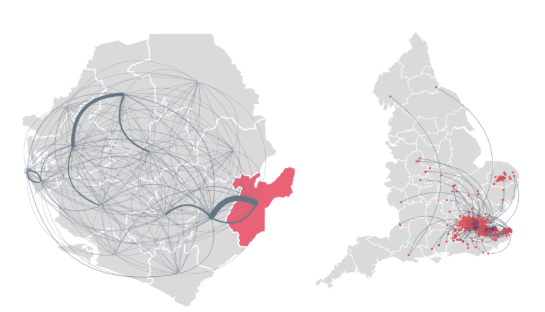
I spend much of my time doing phylogeographic analyses on large and small datasets. These analyses use sample locations to infer how location has evolved along a phylogeny over time: in other words, where and when did the virus move in the past? This can be done in a discrete way, using eg countries as the location, and non-genomic data can be included to find out what predicts movement between locations. Location can also change continuously, enabling a more accurate investigation of how a virus may spread within a country. Both can be used to identify source-sink dynamics and identify targetted non-pharmaceutical interventions.

Practical phylogenetics

Phylodynamics is great, but it’s slow and can be complicated to interpret. Condensing genomic information into easier to understand analyses with quick turnaround times has been an important part of my career so far. I was a co-developer on civet and grinch, both designed to make the huge amount of SARS-CoV-2 genomic data accessible and useable for data producers and the general public respectively. I’ve developed (along with a large global collaboration) a lineage system for Dengue virus to better describe global Dengue diversity, without the need to perform complex analyses.

Outreach

I love sharing my research with other scientists and the wider public, and demystifying virus evolution.

For a number of years, I've organised and/or taught on workshops like VEME to try and widen access to phylodynamics (which is still a very small field).

During the acute years of the COVID-19 pandemic, I took part in panel discussions, and was interviewed for print media and podcasts. I was also included in Breathless by David Quammen. In more recent years, you'll find me in print and on TV dicussing anything other than COVID.

You can find more information in my CV

Opportunities

I don't have any specific opportunities open currently, but I'm always interested in hearing from prospective postdocs or PhD students. I'm happy to work on many virus systems (although would prefer HCV or CCHFV for the moment), so get in touch with what it is about my research that excites you. Please do not use generative AI in your email.

In the UK, PhDs are mostly funded through programmes (e.g. this one). I'm happy to chat about different funding options and put together a proposal for one of the programmes together. Timing-wise, projects are usually submitted to funding agencies in the late summer, and then are advertised in the autumn, to start the following autumn.

Contact

I'm always happy to chat about virus evolution and phylodynamics, whether you're a journalist, new collaborator, or a potential lab member!

Drop me an email on verity.hill@glasgow.ac.uk